Heshan Chen
 Stanford University (MS)
 Columbia University (MPA)
 Boston University (BS)
- EdenScope
- Hatay Multi-Hazard Platform
- AI for aquatic plastic detection
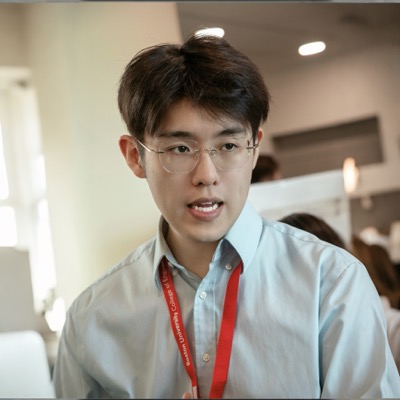
Heshan Chen (陈河杉) is a researcher working at the intersection of artificial intelligence, environmental science, and public policy. He is a graduate researcher at the Lamont-Doherty Earth Observatory and Columbia Climate School, and a pre-doctoral researcher in economics at Peking University's Institute of Carbon Neutrality.1
Chen builds AI systems that bridge technology, environmental science, and public policy. With a background in machine learning, robotics, and emerging media, he focuses on applying advanced models — particularly reasoning-capable AGI prototypes — to solve real-world challenges like urban ecology, sustainable infrastructure, and climate resilience.2
Education [edit]
Chen will attend Stanford University for a Master of Science in Civil and Environmental Engineering (2026–2027), with a focus on environmental economics, foundation models and AI agents, and computer vision for the built environment.3
He received a Master of Public Administration in Environmental Science and Policy from Columbia University (2025–2026), focusing on econometrics, climate system modeling, environmental policy analysis, geospatial AI, and signal processing.4
Chen earned dual bachelor's degrees from Boston University (2021–2025): a BS in Electrical Engineering and Computer Science (EECS) with a concentration in AI and machine learning, and a BS in Cinema Studies and Film Production. His undergraduate focus areas included deep learning, computer vision, reinforcement learning, robotics, and AI for science.5
He was also a Data Science & Policy Scholar at the University of Chicago's Harris School of Public Policy.
Research and career [edit]
Environmental economics and biodiversity
As a pre-doctoral researcher at Peking University's Institute of Carbon Neutrality under Professor Ji Xi, Chen constructed a global biodiversity legislation corpus of approximately 150,000 documents spanning 190+ jurisdictions. He designed a human-AI collaborative classification framework using a fine-tuned GPT-OSS model for multi-label policy taxonomy, targeting CBD strategic objectives, IPBES instrument categories, and Kunming-Montreal GBF targets.6
AI-driven plastic detection
At the Lamont-Doherty Earth Observatory, Chen develops AI algorithms for autonomous plastic detection using a solar-powered catamaran equipped with visible light sensors and hyperspectral cameras. Working with Professor Beizhan Yan and NOAA, he designed multi-sensor data fusion pipelines for real-time classification and a custom NIR LED illumination system for enhanced plastic detection in field deployments.7
Post-earthquake recovery in Hatay
Following the 2023 Turkey–Syria earthquakes, Chen leads development of a multi-hazard digital twin platform for post-earthquake recovery in Hatay Province, combining satellite imagery, structural inventories, and community feedback. The platform integrates AI-driven change detection for tracking building, road, and vegetation recovery, along with CNN-based landslide detection using SAR imagery and flash-flood modeling with compound hazard layers.8
Mekong River hydrology
Chen analyzed the cumulative impacts of 13 mainstream dams on the Mekong River using 65 years of observational data, developing a baseline-pulse framework to quantify upstream-downstream distance effects and constructing flow prediction models for independent hydrological early warning.9
EdenScope
As a featured project at Boston University's Department of Electrical and Computer Engineering, Chen led the design of EdenScope, a multimodal AI system for urban plant health monitoring. The system employs YOLOv12x for segmentation, EdenScopeVL for zero-shot disease classification, and EdenScopeVL-CoT, a chain-of-thought reasoning agent integrating GPS, weather, and soil data. He built cross-platform applications (macOS, web, mobile) with GIS visualization and diagnostic reporting.10
Mathematical reasoning with LLMs
For the AI Mathematical Olympiad, Chen distilled Qwen2.5 with DeepSeek R1 using activation-aware weight quantization, fine-tuned with GRPO reinforcement learning. He implemented chain-of-thought reasoning and self-consistency voting to maximize accuracy.11
Policy research [edit]
Chen serves as a graduate consultant at the New York State Energy Research and Development Authority (NYSERDA), analyzing data center impacts on grid capacity and clean energy targets, leading research on waste heat recovery feasibility, and developing economic policy recommendations for large-scale computing infrastructure in New York State.12
As deputy manager for New York State Assembly Bill A5947 at Columbia's School of International and Public Affairs, he co-led a ten-member team assessing zoonotic spillover risks from wildlife trade, developing data-driven policy recommendations including prohibited-species criteria and One Health-aligned early warning systems.13
Industry experience [edit]
Chen interned at Shanghai Electric Group's Yinghe Technology (2024), developing lithium-ion battery SOH prediction algorithms, and at ARECONN Lab (2023), programming PLC-based servo control systems for Tesla 4680 cell winding lines with deep learning-integrated quality control. He previously held positions at Flying Bark Productions in Sydney and Beijing Yangguang Travel.14
Publications [edit]
- "Building Back Better in Hatay, Turkiye: Co-Designing a Multi-Stakeholder, Multi-Risk Informed Urban Development Approach." Forthcoming.
- CFIT: A Compound Flood Interaction Transformer for Probabilistic Storm Surge Forecasting at U.S. Coastal Stations. In progress.
- Global biodiversity policy classification using human-AI collaborative frameworks. Peking University. In progress.
- AI-driven autonomous plastic detection and capture in urban waterways. Lamont-Doherty Earth Observatory. In progress.
References [edit]
- Peking University, Institute of Carbon Neutrality — researcher profile.
- Personal website. heshanchen.com.
- Stanford University, School of Engineering — admitted students 2026.
- Columbia University, School of International and Public Affairs — MPA program.
- Boston University, College of Engineering — EECS program.
- Chen, H. et al. "Global biodiversity policy classification using human-AI collaborative frameworks." Working paper, Peking University.
- Lamont-Doherty Earth Observatory, Plastic Cleanup Project — NOAA Sea Grant.
- Chen, H. et al. "Building Back Better in Hatay, Turkiye." Working paper, Columbia Climate School.
- Chen, H. "Hydrological Impacts of Damming in the Mekong River Basin." Lamont-Doherty Earth Observatory, 2025.
- Boston University ECE — EdenScope Featured Project, 2024–2025.
- AI Mathematical Olympiad competition records.
- NYSERDA — "Computing the Costs & Benefits: Data Centers, Grid Policy, and Clean Energy in New York."
- New York State Assembly Bill A5947 — legislative research, Columbia SIPA.
- Shanghai Electric Group — internship records 2023–2024.